
Quick answer
A solo mobile auto detailing business can generate $50,000 to $150,000 in annual revenue, with owner pay typically landing between $35,000 and $100,000 after expenses and taxes. Most detailers start part-time while keeping their day job, reinvesting early profits into better equipment and marketing.
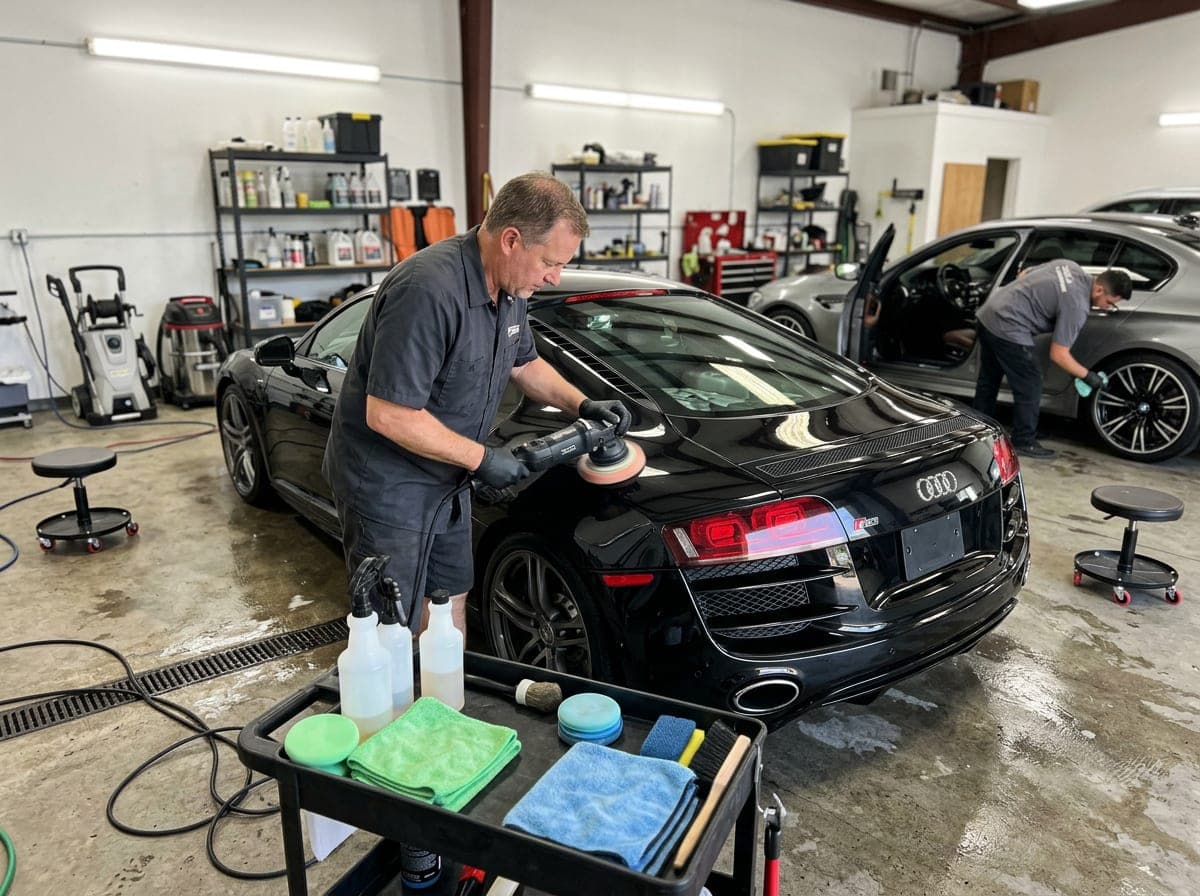
The Three Income Paths
Auto detailing offers three distinct income paths, each with different ceilings and trade-offs. Understanding where you fit helps set realistic expectations.
Employed Detailer
Working for someone else as a detailer pays $15 to $25 per hour. That translates to roughly $31,000 to $52,000 per year for full-time work. You get steady pay, no business headaches, and no financial risk. But your income is capped by the hours you work and the rate your employer sets. There's no path to significant wealth on this route.
Solo Owner-Operator
This is where the real money starts. As a self-employed mobile detailer, you keep the full job price minus your expenses. A $200 detail that takes three hours effectively pays $66 per hour before costs, far more than any hourly wage. Solo operators typically gross between $50,000 and $150,000 annually, depending on pricing, efficiency, and how many days they work.
Real-world example: One mobile detailer grossed $120,000 per year working 6-8 hours per day, five days per week. After expenses, they took home roughly $72,000 before taxes. Another detailer in their second year grossed $150,119.50 with $70,000 in profit.
Business Owner with Team
The highest ceiling comes from building a business that works without you. Shop owners with employees can generate $300,000 to $500,000 or more in annual revenue. One Detroit-area shop owner with 12 employees across two locations averaged $55,000 per month in sales, bringing home $15,000 to $20,000 in monthly profit.
This path requires systems, hiring, and delegation. You trade hands-on detailing for managing people, marketing, and operations. It's a completely different skill set, but it's the only route to serious wealth in this industry.
Revenue vs. Profit vs. Owner Pay
Most articles blur these three numbers, which creates massive confusion. Here's the distinction:
Revenue is everything customers pay you. If you do three $200 details in a day, your revenue is $600.
Profit is revenue minus your business expenses. Using the same example: $600 revenue minus $60 in supplies, $30 in fuel, and $20 in equipment depreciation leaves $490 profit.
Owner pay is what you actually take home after profit, taxes, and reinvestment. From that $490 profit, you might pay $120 in taxes and reinvest $100 into new equipment. Your owner pay is $270.
A detailer who says "I made $150,000" might mean revenue, profit, or owner pay. Always ask which number they're talking about. The difference between gross revenue and take-home pay is often 50% or more.
The Profit Model Explained
Here's the formula that determines your owner pay:
Owner Pay = Revenue - (Supplies + Labor + Overhead + Taxes + Reinvestment)
Let's walk through a real example. You charge $200 for a full interior and exterior detail. Here's where that money goes:
| Item | Amount |
|---|---|
| Revenue | $200 |
| Chemicals | $25 |
| Towels and applicators | $10 |
| Your labor (2 hours at $20/hour) | $40 |
| Fuel and misc. | $5 |
| Total costs | $80 |
| Profit | $120 |
| Profit margin | 60% |
That 60% profit margin is typical for detailing services. But your owner pay is lower because you still have to cover fixed monthly expenses and taxes.
Build Your Profit Model Step by Step
Creating your own profit model takes about 30 minutes. Here's the process.
Step 1: Set Your Prices
Start with your base price for a sedan. Then apply vehicle size multipliers:
- Sedan or coupe: 1.0x base
- SUV or crossover: 1.2-1.3x
- Large SUV or truck: 1.4-1.5x
- Van or commercial: 1.5-1.7x
Industry-standard pricing for a full detail ranges from $150 to $300+. Many successful detailers use tiered packages:
- Standard detail: $85-$125
- Wash and seal: $135-$175
- Premium full detail: $335-$450
Step 2: Calculate Cost Per Job
Track every cost associated with completing one job:
- Chemicals: $10-$50 depending on services
- Towels and microfiber: $5-$15
- Equipment depreciation: $2-$10 (divide equipment cost by expected job count)
- Fuel and drive time: $5-$20
- Payment processing fees: 2-3% of job price
For most services, supplies consume 10-20% of revenue. A $200 detail typically has $25-$40 in direct costs.
Step 3: Estimate Monthly Overhead
Fixed costs stay the same regardless of how many cars you detail:
- Mobile detailer: $500/month (vehicle maintenance, marketing, software)
- Shop-based: $3,000-$5,000/month (rent, utilities, insurance, marketing)
Include insurance ($89/month for a business owner's policy), software subscriptions, phone, and marketing.
Step 4: Find Your Break-Even Point
Break-even jobs = Monthly overhead ÷ Profit per job
If your overhead is $500 and you make $120 profit per job, you need 4.2 jobs per month just to cover fixed costs. Everything after that is owner pay.
Step 5: Project Your Revenue
Annual revenue = Jobs per day × Working days per year × Average ticket price
A solo detailer doing 3 jobs per day at $160 average, working 250 days per year:
- 3 × 250 × $160 = $120,000 annual revenue
Step 6: Calculate Owner Pay
Owner pay = (Annual revenue - Annual costs) × (1 - Tax rate)
Auto Detailing Owner Pay Calculator
type your own numbersUsing the example above:
- Annual revenue: $120,000
- Supplies (15%): $18,000
- Overhead ($500/month): $6,000
- Fuel and misc: $5,000
- Profit before tax: $91,000
- Taxes (25%): $22,750
- Owner pay: $68,250

Realistic Income Scenarios
Here are three realistic scenarios showing the full financial picture.
Scenario A: Part-Time Mobile Detailer
You keep your day job and detail on weekends.
- Jobs per week: 4
- Average ticket: $150
- Working weeks per year: 48
- Annual revenue: $28,800
- Supplies (15%): $4,320
- Overhead ($300/month): $3,600
- Fuel and misc: $2,000
- Profit before tax: $18,880
- Taxes (25%): $4,720
- Owner pay: $14,160
This is realistic for year one while you build skills and reviews.
Scenario B: Full-Time Solo Mobile Detailer
You've built a client base and work consistently.
- Jobs per day: 3
- Working days per week: 5
- Average ticket: $160
- Working weeks per year: 48
- Annual revenue: $115,200
- Supplies (15%): $17,280
- Overhead ($500/month): $6,000
- Fuel and misc: $5,000
- Profit before tax: $86,920
- Taxes (25%): $21,730
- Owner pay: $65,190
This matches real-world reports from established solo operators.
Scenario C: Shop Owner with Team
You've hired 2-3 detailers and manage operations.
- Jobs per week: 40
- Average ticket: $200
- Working weeks per year: 50
- Annual revenue: $400,000
- Supplies (15%): $60,000
- Employee wages: $120,000
- Rent and utilities: $48,000
- Insurance and software: $18,000
- Marketing: $12,000
- Profit before tax: $142,000
- Taxes (25%): $35,500
- Owner pay: $106,500
This requires systems, hiring, and consistent marketing. It's the path to serious income.
The Levers That Increase Owner Pay
Six factors determine your income. Focus on these in order.
Raise Your Prices
The fastest way to increase profit is charging more. If you're at $150 per detail and competitors charge $200, you're leaving money on the table. Raise prices 10-20% and see what happens. Most detailers find they lose few customers and gain significant profit.
Add High-Margin Services
Ceramic coatings ($500-$2,000), paint correction ($600-$2,000+), and add-ons like headlight restoration ($50-$100) have 66-80% profit margins. One ceramic coating job can equal the profit of four basic details.
Build Repeat Clients
A repeat customer is the cheapest, most profitable client you'll ever have. Offer maintenance packages, follow up after appointments, and create a referral program. A base of 50 regular clients who book every 2-3 months provides stable, predictable income.
Increase Efficiency
Time is your most limited resource. Batch jobs in the same area, use foam cannons and dual-action polishers, and develop a systematic workflow. Cutting 30 minutes per job lets you fit an extra job into your day.
Add Employees Strategically
When you're booked 2+ weeks out consistently, it's time to hire. A helper at $15-$20/hour lets you take more jobs without working more hours. The profit from their labor goes to you.
Track Every Expense
You can't manage what you don't measure. Use QuickBooks or a simple spreadsheet to track every dollar. Monitor your profit per job, jobs per day, and repeat rate. Small leaks, like replacing microfiber towels monthly or paying for software you don't use, eat into profit.
Common Profit Killers
Avoid these mistakes that destroy detailing businesses.
Underpricing Services
Competing on being the cheapest is a race to the bottom. There's always someone willing to do it for $20 in a parking lot. Price for the quality and convenience you deliver. Premium pricing attracts better clients who value your work and refer others.
Ignoring Supply Costs
Cheap chemicals can damage cars, creating liability. Microfiber towels wear out and need replacement. Track these costs carefully, they typically consume 10-20% of revenue.
Inefficient Workflow
Spending six hours on a job that should take three cuts your profit per hour in half. Invest in quality equipment and develop a repeatable process. Time yourself on each job and look for bottlenecks.
Skipping Insurance
General liability insurance costs about $89 per month. One accident, a scratched panel or damaged interior, can wipe out months of profit. Insurance is non-negotiable.
Neglecting Marketing
Without new clients, your business stagnates. Google reviews are the #1 driver of new business. Ask every satisfied customer for a review. Maintain an active social media presence with before-and-after photos.
Not Tracking Finances
Many detailers have no idea whether they're profitable. They know what they charge but not what jobs actually cost. Track every expense from day one. Use the profit model above to know your numbers.
The Timeline to Realistic Income
Detailing income grows in stages. Here's what to expect.
Year One: Learning and Building
Most detailers make $20,000 to $40,000 in their first year. You're learning the craft, building reviews, and figuring out pricing. Offer discounted details to friends and family in exchange for honest feedback and reviews. Focus on quality over quantity.
Year Two: Optimizing
With experience comes efficiency. You can charge more and complete jobs faster. Revenue typically jumps to $50,000 to $80,000. This is when you refine your service menu, raise prices, and build a repeat client base.
Year Three and Beyond: Scaling
Detailers who build systems and market consistently reach $100,000+. This is when you add employees, expand services, or open a shop. The ceiling depends on how much you want to grow.
The Business vs. The Job
Here's a critical distinction: a solo owner-operator is selling a job, not building a business. Your income stops when you stop working. The business has value only if it can run without you.
To build real wealth, you need systems, employees, and processes that let the business operate independently. This is the difference between earning $100,000 and building a $300,000 business.
Your Next Steps
Building a profitable detailing business starts with the numbers, not the equipment.
- 1
Build your profit model today.
Use the steps above to calculate your pricing, costs, and break-even point before you spend a dime on equipment.
- 2
Start part-time if possible.
Keep your day job while you learn the craft and build a client base. The financial risk is minimal, and you can test the market without pressure.
- 3
Price for profit, not popularity.
Use the formula: Price = Cost ÷ (1 - Desired Margin). If a job costs $50 and you want 60% margin, charge $125.
- 4
Track every expense from day one.
Use a spreadsheet or accounting software. Know your profit per job, jobs per day, and monthly overhead.
- 5
Focus on high-margin services.
Learn ceramic coating and paint correction. These skills separate $50,000 detailers from $150,000 detailers.
The detailing industry is growing, with mobile services expanding at 19% annually. The demand exists. The question is whether you'll build a profitable business or just a busy one. The answer starts with understanding your numbers.