
Quick answer
To grow a detailing business past $10k/month, stop competing on price alone. Define whether that means $10,000 in revenue or $10,000 in profit to you, then measure your true time and costs per job. Choose a business model that fits your capacity: an efficient maintenance model (higher volume, lower tickets), a premium retail model (fewer jobs, higher tickets, add-on services), or a B2B/specialty model (contracts with dealerships, fleets, and other businesses).
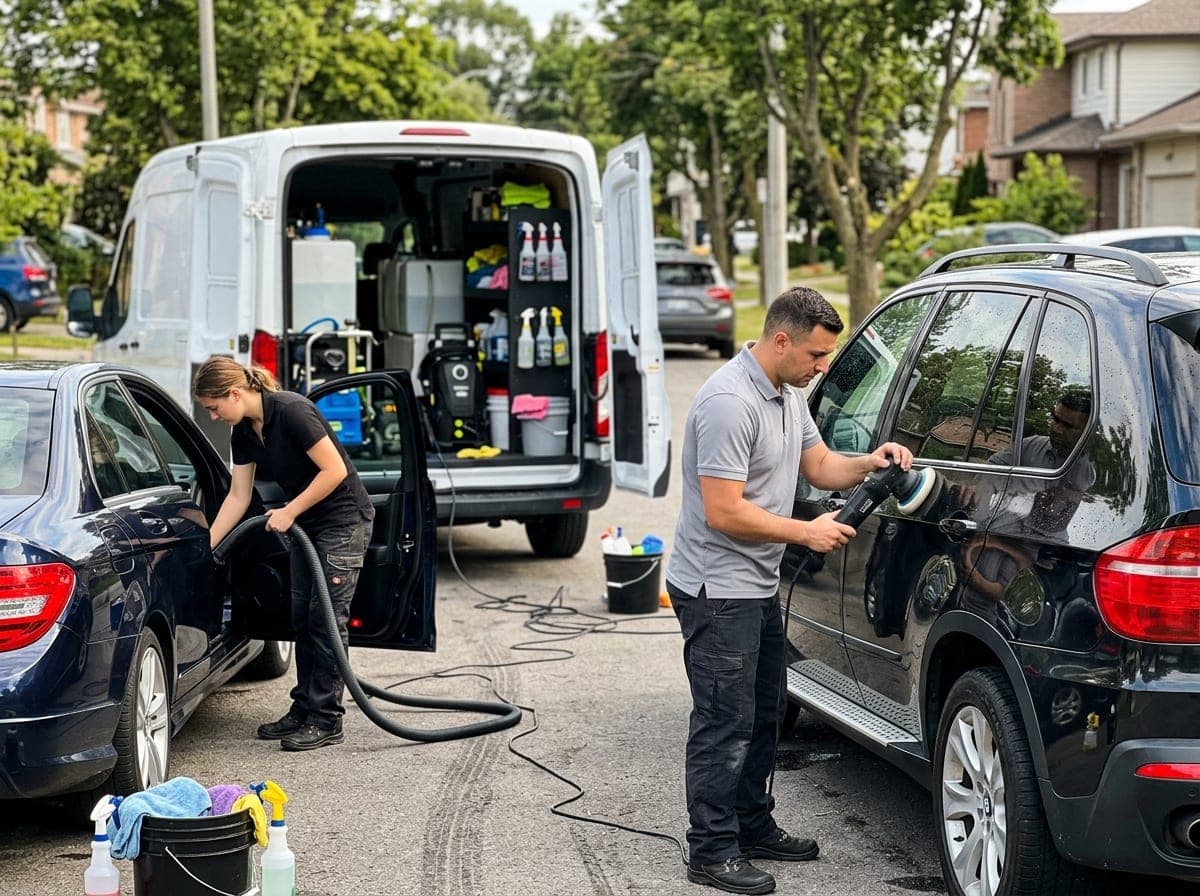
From Service to System
You're a skilled detailer. You produce insane before-and-after transformations. Your customers leave happy. Yet you're stuck at the same revenue ceiling month after month, somewhere in the $3,000 to $7,000 range, and you're working harder than ever just to stay there.
Here's the reality: the problem isn't your skill. It's your business model.
You can't polish your way to sustainable growth. You need to build a business, not just book appointments.
Now, let's build the full playbook.
Define What "Past $10k/Month" Means to You
The sentence "grow a detailing business past $10,000/month" implies gross revenue. But there's a major difference between:
- $10,000 in gross monthly revenue
- $10,000 after direct expenses
- $10,000 in your personal compensation
- $10,000 in net business profit
If your goal is $10,000 in personal income, after paying for supplies, insurance, fuel, equipment, marketing, and taxes, your revenue target may need to be $13,000, $15,000, or even higher, depending on your true costs.
| Monthly revenue | Direct costs and overhead | Owner compensation/profit |
|---|---|---|
| $10,000 | $4,000 | $6,000 |
| $15,000 | $6,000 | $9,000 |
Before you set a revenue target, set a profit target. "Making more money" is not a business strategy. What number, after all expenses, actually changes your life? That's your real target.
For consistency, the rest of this article will use "$10,000/month" as gross revenue. Just remember: your personal take-home will be less until you capture pricing, volume, and systems that produce enough margin.
The Math of Reaching $10k/Month
Most detailers think in terms of car counts. Let me show you why that's a trap unless you deliberately choose it.
Let's say you run 20 working days per month and you want to hit $10,000 in gross revenue. That's $500 per day. Simple enough.
But here's where detailers go wrong. They try to reach that number by doing more jobs at lower prices, which breaks the body and leaves no time for business development.
The real formula is:
Monthly revenue = billable jobs × average ticket
And the second formula that matters:
Required production hours = jobs × average hours per job (including travel, setup, inspection, cleanup)
| Model | Jobs/month | Average ticket | Revenue | Total hours/job | Monthly production hours |
|---|---|---|---|---|---|
| Maintenance-volume | 60 | $170 | $10,200 | 1.5 | 90 |
| Full-detail (blended) | 30 | $335 | $10,050 | 3.5 | 105 |
| Premium (low-volume) | 15 | $675 | $10,125 | 6 | 90 |
Notice that the "premium" path doesn't necessarily require fewer production hours than the maintenance path, because high-end jobs take longer. What changes is the nature of the work and the customer you serve.
This is the choice:
The Volume Trap
- 4 cars per day at a $125 average ticket
- 80 cars per month
- Consistently booked but exhausted
- No time for marketing, admin, or family
- One equipment failure or rainy week and the whole system crumbles
The Premium Path
- 1–2 cars per day at a $400–$600 average ticket
- 25–40 cars per month
- 4–6 hours of focused, quality work per job
- Energy left for running the business, not just working in it
- Better gross margins per production hour if your services are priced correctly
There's also the B2B path: one commercial contract with a dealership (5–10 units per week) can secure you a $2,000–$4,000 monthly retainer, and it operates from a different set of constraints, more predictable volume, slower payments, but less per-job marketing.
The truth: no path is universally better. There is the right fit for you based on your capacity, market, and goals.

Know Your Numbers, Or Be Guessing
I meet detailers all the time who tell me they make "$150 per detail." But when I ask what their profit is after supplies, drive time, overhead, and the hours they lose to admin, they have no idea.
The number that matters isn't your ticket. It's your effective hourly rate as a person and your business's contribution margin per job.
Track three different numbers:
- Direct job cost, chemicals, consumables, card fees, outsourced labor
- Owner labor allocation, what your production time is worth (you should already be worth something per hour)
- Operating overhead, insurance, software, fuel, equipment replacement, marketing, taxes
Contribution Margin = Price − Direct Job Cost
Owner Operating Profit = Contribution Margin − (Owner Labor Allocation + Overhead Allocation)
Only after direct costs, labor, and overhead can you see your true operating profit.
How to price intelligently
Most detailers underprice because they don't know their true costs. Here's a pricing sequence that will never steer you wrong:
- 1
Measure the true time required
Use a lap counter or detailsheet: production time, travel time, setup, and cleanup.
- 2
Set a target effective hourly rate
This is what you want to earn as the owner-technician or the owner who pays labor.
- 3
Add direct job costs
- 4
Add overhead allocation per job
Total monthly overhead ÷ expected job count.
- 5
Add a profit margin
To guarantee business survival and future growth.
A simple formula:
Price = Direct Cost + (Target Hourly Rate × all hours) + Overhead Allocation + Profit Target
Example: If your direct cost is $6, you spend 4 hours on a detail (including travel), and you want to earn $50/hour plus 30% net profit:
Example detail price
Price = ($6 + $200 + $15) / 0.70 = $316
Detailing price calculator
type your own numbersUse your actual direct cost, total hours, target hourly rate, overhead allocation, and profit margin.
If that price doesn't work for your market, you have only two real choices: reduce the time, or reduce your overhead per job by optimizing your radius. You can't just skip the numbers.
Stop Competing on Price: The Real Reason It Matters
Let me say something blunt: if you're permanently charged $150 for a full detail and unable to raise it, that's a business model. It's a ceiling, one that makes hiring, marketing, and reinvestment nearly impossible.
But "charge $150" isn't the same as "charge $400–$600 no matter what." Pricing is not one-size-fits-all. It depends on your market, services, skill level, time, quality of proof, and the customer you're targeting.
That said, the goal isn't just "raise the price and imply quality." The goal is to add to your ticket with services that justify a higher price: paint correction, ceramic coating installation, interior restoration, headlight restoration, each of which requires special skills and equipment.
The Psychology of Price: What's Actually True
Yes, some is core: some customers with a low price and also feel the highest. But charging more doesn't automatically make you "the best." Your proof, your reviews, your photos, your professionalism, your insurance, your consistency, is what justifies the price.
Instead of preferring "premium," teach customers outcomes:
Instead of this: "We do a full detail that includes wash, vacuum, windows."
Use this: "Our signature package preserves your paint, removes allergens, and leaves your car protected against the next six months of weather. You can also add ceramic treatment for easier washings."
People don't buy "effort." They buy the outcome of that effort.
The true risk of "Low Price SEO"
If you're charging $150 for a full detail and it takes you 4 hours, your effective rate is $37.50/hour before expenses. That will tell you that charger is a "bad customer." People who seek the absolute lowest price tend to:
- Demand the most time for rework
- Abandon you for the next cheap option
- Fail to refer the right kind of customer
That's not a law, volume model. But for most solo operators, constantly underpricing creates a ceiling on your earnings and your energy.
The Real Margins: Why Add-Ons Are the Key
Your "margin numbers" must always include labor hours and risk, not just product cost.
| Service | Typical price range | Typical time | Real direct materials | Real risk & effort | Skill level |
|---|---|---|---|---|---|
| Full interior/exterior detail | $200–$400 | 3–5 hours | $5–$15 | Moderate | Core skill |
| Paint correction (single stage) | $400–$800 | 4–8 hours | $10–$20 | High skill; labor is the cost | High |
| Ceramic coating (2-yr, incl. prep) | $800–$1,500 | 4–6 hours | $50–$150 | High skill; warranty risk | Advanced |
| Headlight restoration | $75–$150 | 1 hour | $5–$10 | Medium; condition varies | Moderate |
| Pet hair removal | $50–$150 | 1–3 hours | $5 | Labor-heavy; hair type | Moderate |
| Odor treatment | $75–$200 | 1–2 hours | $10–$30 | Varies; source matters | Moderate |
The fastest way to raise your average ticket:
- Add 1–2 services from the table to your "mandatory recommendations" based on condition.
- Train or learn proper execution.
- Price them correctly, not as optional extras to "sell," but as threshold services that solve a problem (stains, headlights, pet hair, protection).
The Service Menu Is Your Product
If you're charging a flat $150 for everything, from a two-door weekend car to a dirty third-row SUV with dog hair, you're doing two things wrong: you're underpricing time-intensive vehicles, and you're not serving the customer's.
Rebuild your menu logic:
The Essential Package ($200–$350 depending on size/condition)
- Exterior wash and decontamination (clay bar)
- Interior vacuum and wipe down
- Windows and interior glass
- Wheel + tire dressing
- Best for existing customers in a monthly maintenance routine
The Signature Package ($400–$700)
- Full interior vacuum, steaming, and deep cleaning
- Interior plastic/recondition + leather wipe
- Exterior clay bar and one-step polish
- Paint sealant or synthetic wax
- Glass and trim dressing
- Engine bay wipe down (add-on optional)
The Showcase Package ($800–$1,500+)
- Signature everything
- Multi-step paint correction
- Ceramic coating application (2-year to 5-year lifespan)
- Headlight restoration
- Leather, plastic, and trim precondition
- Optional polishing, seat, and carpet shampooing
- Complimentary maintenance-plan discount
A critical note: If you can't deliver the protection promised by coatings or correction with proper training, don't include it. A bad outcome costs far more than lost revenue from a declined sale.
How to pick your menu:
- Which services have you actually trained for?
- Which services do you enjoy doing?
- Which services have a true hourly margin of $50+ after all time items?
- Which services generate repeat maintenance work?
Now, not every detailer can do high-end work. And that's okay. The maintenance model is also valid.
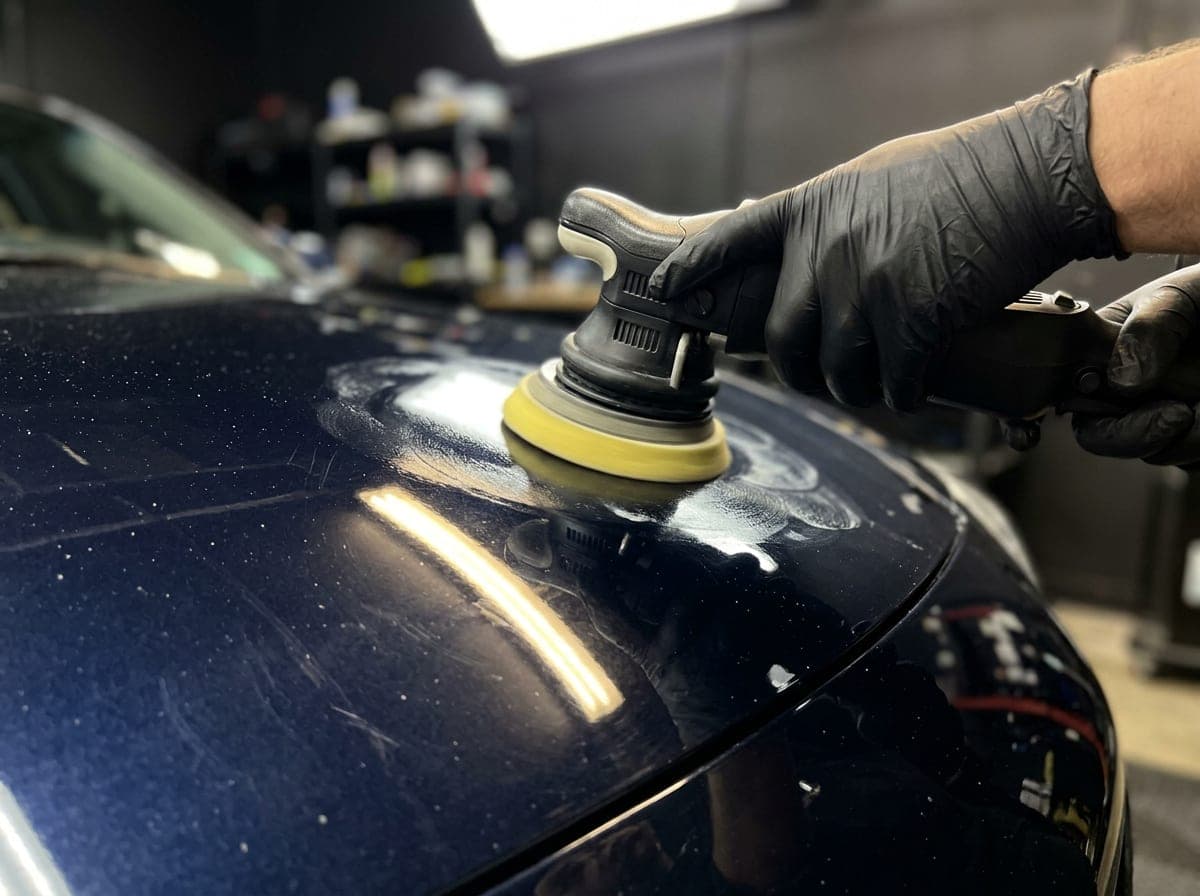
Operational Elegance: Systems Before Scale
You can't reliably grow past $10k/month if growth depends on you remembering.
The Minimum Viable Tech Stack:
- Online Booking & Scheduling: Let clients choose a package, select a time slot, and pay a deposit, 24/7, without you on the phone.
- CRM: Store client history, service intervals, and follow-up schedules.
- Invoicing + Payments: Get paid the moment the job is done. No "tgif I'll text you later," no chasing checks.
These tools don't just save time, they improve speed, reduce friction, and build trust.
Create Standard Operating Procedures (SOPs)
Document your workflow:
- Which products and tools are used in which order
- What to inspect before you start
- How to handle damage in a vehicle
- How to request payment and reviews
- How to deal with lost time or a bad-day
SOPs make it possible to train a helper, which is how you eventually stop being the bottleneck. The five-step ladder:
- 1
You do everything
Detail, book, support, market
- 2
You detail
Software handles bookings and reminders
- 3
A helper handles service coordination
Or is hired as detailer
- 4
You sell, market, and manage
While your team produces
- 5
You step out entirely
Oversee offers, systems, and cash flow
The "Potential Hiring Rule"
Don't hire just because you're busy. Be objective. Only hire when you've hit all the readiness rules:
- You're consistently booked more than a week in advance
- You've documented your production times and cost
- Your service menu is standardized
- You have enough demand to fill the new person's weekly hours
- Gross margin and cash reserves are enough
- You've got at least 3 months of overhead reserved
- You have documented QA standards, or train carefully
Hiring vs. Subcontracting, get advice from a local accountant or employment lawyer. And always: remember labor taxes, insurance, and worker classification rules.
A Marketing System That Works (Without Relying on Liars)
Good reviews are your #1 salesperson. But don't game the system.
Get honest excellent reviews (without breaking rules or trust):
- 1
Ask every satisfied customer in-person or via a delivered message
"I'm working on building my Google reviews, would you say I'm a 5-star business?"
- 2
If yes
Send them a direct link.
- 3
If they say "not 5,"
Listen to feedback and fix that problem.
- 4
Never offer a discount for a positive review
This violates Google's policy and can harm trust.
Instead, incentivize referrals, that's allowed. And referred customers become loyal:
- Referrer gets, a discount or free add-on on their next visit
- New client gets, a modest new-client discount
That's a genuine referral machine, not a review game.
Before/After Proof
Use photos and short videos. But "the most persuasive marketing" is a combination of: reviews + videos + before/after + clear offers. Each matters differently for each customer.
Avoid "abs" and "the best." Instead, say: "The strongest lead generators we see are photos of the same car in the same spot before/after, video of the detail, and a 30-second walk-around."
Beyond Retail: B2B and Niche Opportunities
The biggest untapped opportunity in the detailing world sits outside standard retail.
What Works in B2B
- Dealerships: Need reconditioning for trade-ins, pre-delivery, and special requests. Ask about frequency, turnaround, pickup, and payment terms.
- Body shops: Need final paint correction, polish, and final prep before delivery.
- Rental agencies: Need high-volume turnaround work, but expect strong margins if heavily deal-based. Deals are hard.
- Fleet managers (construction, corporate sales): Need regular vehicle interior/exterior maintenance for their fleet.
- Real estate agents / luxury property managers / concierge: Vehicle cleaning to stage a beautiful property, gift to buyer/seller, or property access.
- Boats/RVs/motorcycles sometimes, but each niche has: specialized equipment, water/sewage rules, insurance, and safety procedures. Never hesitate to test.
The outreach cold-call framework (by email or LinkedIn):
- 1
Intro
"I run Burley's Auto Detailing, we work with [Fleet/Dealer/etc]. I've spent your past 48 hours looking at your specific needs."
- 2
Value
"I handle reconditioning weekly, I can pick up, detail, and return your units within 48 hours, with a photo report of the result."
- 3
Trial
"I'll do a trial for 2 cars for at discounted cost so you can see our proof."
- 4
Call to action
"When's a good 15 minutes this week to discuss?"
But: B2B can eat your time in sales, turnarounds, and phone calls. Evaluate each account BEFORE you enter.
Qualification questions (for any partnership):
- How many jobs/units do they actually need per month?
- What's the required turnaround?
- Who approves vendors?
- Do they pay quickly (30 days or less)?
- What's the expected price, does it include your real margins?
- Is the account time-efficient (pickup/dropoff location)?
A 90-Day Operating Plan to Get to $10k/Month
Growth doesn't happen from overwhelm. It happens from intentional weeks.
Days 1–14: Measure Everything
Track every single job:
- Ticket price
- Production time
- Travel time
- Supplies $ per job
- Lead source (review, referral, walker, ad, partnership)
Calculate:
- True hours/job
- Effective hourly revenue ($/total hours)
- Which services are your highest-margin and top performers
Days 15–30: Rebuild the Offer
- Discontinue weak services (or "shadow" them into add-ons)
- Create a 3-package menu, priced by your hours (not guesswork)
- Require a deposit at booking, preference for all jobs
- Set payment terms: deposits, invoices, final on delivery
Days 31–60: Improve Acquisition
- Optimize your Google Business Profile with photos, 50+ reviews
- Set up automated appointment after job completion
- Implement a referral program (double-sided)
- Actively call 5–10 qualified businesses in your area using the outreach framework
- Track: Lead response time, booking rate, customer acquisition cost
Days 61–90: Make Room to Scale
- Pre-book maintenance clients (maintenance hourly or package)
- Create an SOP for your top-three jobs
- Build a pick-list of all parts/chemicals
- Test a part-time helper or subcontractor only if the numbers support a 4-day week paid weekly
Your KPI Dashboard
As business grows, you can't rely on intuition. Focus on these:
- Lead response time (target under 1 hour)
- Qualified lead: (incoming date, not the number of phone numbers)
- Booking rate (% of qualified leads booked)
- Customer acquisition cost (total marketing spending ÷ new non-referral customers)
- Average ticket ($ total / per job)
- Revenue per production hour (revenue ÷ all hours incl. travel/admin)
- Contribution margin (after direct costs/atlas)
- Job cost accuracy (compared to expected)
- Repeat rate (share of recharges in next 30/60/90 days)
- Rework/cancel rate
If your average ticket is $150 and your customer acquisition cost is $45, you have a low-margin business. If your contribution margin is 60% and unlimited customer value is $500, then adding more $200 maintenance clients is likely good.
The Bottom Line
Getting past $10k/month is not about hustling into burnout. It’s about building a profit machine that runs on systems, not just sheer will.
- Know: "10k" theory vs. "10k" profit, and pricing for that
- Book capacity, time and real costs
- Choose a business model (maintenance, premium, B2B) grounded in data, not just "charge more"
- Track small KPIs, the 10 numbers that tell you what's working
- Install systems (software, SOPs, referrals, partnerships)
- Hire only when ready, using your capacity, time
You have the skill. You have the work ethic. Now build the scalable systems, measure your numbers, and make clear, strategic choices. That's the game plan to cross $10k/month, and you can do it this year.