
Quick answer
Every month you hold off on an increase, you're absorbing rising costs of shampoo, equipment, insurance, and rent that the groomer down the street hasn't faced either. Here's the answer that changes everything: a well-planned increase, communicated with confidence and lead time, costs you almost nothing.
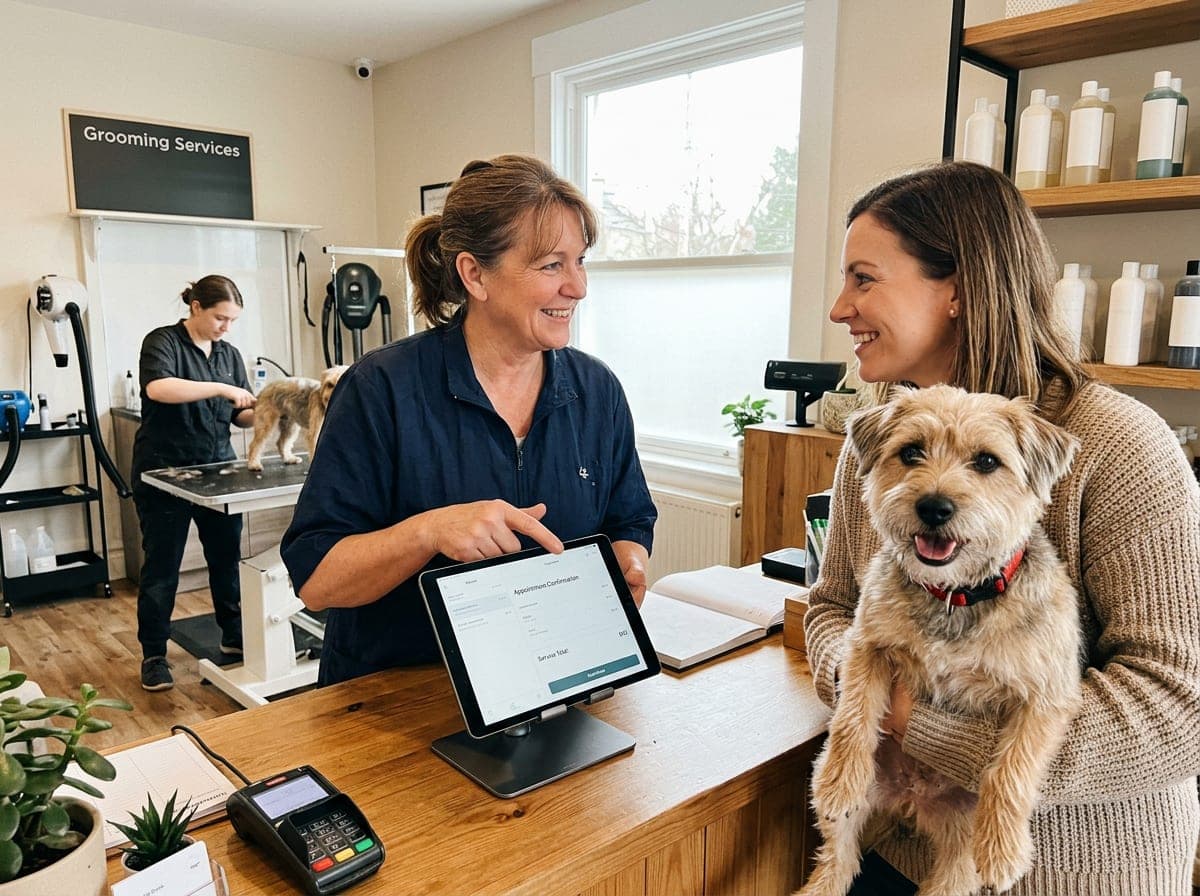
The Fear Is Real
Most groomers underprice their work, often by 15–30%.
And that gap is costing you more than you think.
But the fear is real. What if clients walk? What if people are angry? What if you're forced to back down?
And losing even a few clients can still leave you making more money with a lighter schedule.
This is the step-by-step of how to do it without wrecking your client list.
The Real Math
Let's start with the numbers because the math will give you a courage that isn't blind confidence. Say you groom 40 dogs a week at $85 each. That's $176,800 a year.
Now suppose you only have 30 weekly clients:
| Scenario | Weekly appointments | Price per groom | Weekly gross |
|---|---|---|---|
| Current | 30 | $55 | $1,650 |
| After 15% increase | 30 | $63 | $1,890 |
| After losing 3 clients | 27 | $63 | $1,701 |
Three clients walk, and you're still making $51 more per week, while doing three fewer grooms. That's the same money for a lighter schedule.
There's a formula to remember. Your break-even attrition, the point where you're making the same gross revenue, is:
Break-even retention = 1 − (old price ÷ new price)
So if you raise from $80 to $92, you can lose roughly 13% of appointments and still make the same gross revenue. Your goal will be to attract a better set of clients who fit your new position.
Grooming Price Increase Calculator
type your own numbersYour goal will be to attract a better set of clients who fit your new position.
How Much to Raise
The sweet spot is 5–10% every 12–18 months. If you've only skipped a year or two, a one-time catch-up of 10–15% is justified. Jumping 20% or more in a single step causes sticker shock, so avoid it unless you have deep cash reserves and a long upgrade roadmap.
Rather than equal everywhere, if you have services that are underpriced by the clock, you may want to adjust them more.
A 3-hour doodle groom should cost more than a 45-minute bath coat. If those two are the same price, you're paying to work harder. Raise the expensive ones more and consider freezing the entry-level bath only if it's profitable enough to be a gateway, not if it's a loss leader dragging you down.
What Is Your Actual Hourly Rate?
You don't need a fancy formula. You need to know the number.
Historical effective rate: Take last month's revenue, subtract all expenses (rent, products, insurance, utilities, supplies), and divide by every hour you worked, including booking, cleaning, and the rare pickup. Most groomers are shocked to land between $18 and $28 an hour.
Required service rate: If you want $80,000 in personal income and your overhead costs are $35,000, that's $115,000 total needed. Divide that by realistic productive hours, not the 40 hours you're at work but the 25–32 hours you actually spend grooming after admin and cleanup.
Required service rate
Factor in taxes, equipment replacement, and a reserve, your rate likely needs to be higher.
If you're charging $50 an hour, now you know your gap.
The Rollout: A 30-Day Plan
The style of it all is the execution. here's the plan.
- 1
Choose your date.
Pick a month when you're consistently booked. If you're turning clients away, you're underpriced. January is clean and predictable. Avoid Thanksgiving, Christmas week, or right after a bad event.
- 2
Give 30 days' notice.
Text or email each individual client at least 4 weeks before the new price takes effect. No one should hear it at the counter or see it on a list.

Tell them in person too. At pickup before the change, say:
"One quick thing, just so there are no surprises, next appointment will be [new price] instead of [old price]. First change in [a long while]. Everything else stays exactly the same. See you then."
Say it calmly, like the matter-of-fact statement it is.
The Email That Works
You don't need a novel. Short, warm, and guilt-free. Here's the template:
Subject: A quick note before [Dog's Name]'s next groom
Hi [Name], Just a quick heads-up. From [Date], a full groom goes from [old price] to [new price]. It's the first increase since [Year]. This lets me keep covering what good grooming actually costs, quality products, insurance, and equipment that lasts. I'd rather tell you straight than quietly shorten anyone's time on the table. A full groom takes the same time it always did, so the only honest way to cover rising costs is the price itself. Your slot, your groomer, and the finish stay exactly the same. Any questions, just reply directly. See you on [Date]. [Your Name]
Text version for regulars:
Hi [Name], just so there are no surprises, [Dog]'s full groom goes to [price] from [Date]. Same slot, same finish. Any questions, just text back. [Your Name]
How to Handle Pushback
You'll hear three comments:
- "That a big jump." → "It's been [X] months since I changed anything, but costs went up across the board. The reliability and finish he gets are the same."
- "The other groomer is cheaper." → "They might be. What I can tell you is what's included here including one-on-one time from start to finish, and the same groomer each time. If you'd like, we can walk through exactly what's in the groom."
- "Can I get a discount?" → "We keep our pricing the same for everyone. But if budget's a concern, we can show you a bath-and-brush option that covers the essentials."
What you should not say: "I'm so sorry to have to do this," "due to the economy," or any phrase that sounds like you're asking permission.
If a client says "I'll have to think about it," reply politely: "Of course, the door is always open."
What If They Leave
Some will leave, and that's normal. But don't assume they were bad clients. Some are simply outside your new price range. Let them leave gracefully, with a warm customer service practice:
"You've been wonderful to work with, please feel free to come back on the door is open."
What you'll notice: the clients who complain at you are usually the ones who make everyone else hoarse, chronic cancellers, negotiators, demands (e.g., last-minute rebookers) who were a drain on you to have more than a loss when they leave. Losing open slots often creates space for clients who value each other.
Grandfathering: The Exceptions
The rule: don't grandfather existing clients at the old price indefinitely. That creates a two-tier system where word gets around.
But honor already-booked appointments, then the shift begins. A short transition window can reduce shock in years when you've let prices go stale; but make it a time-bounded policy, not a get-out-of-the-price-for-life card.
If a long-term client is genuinely struggling (a job loss or a health crisis), don't discount the full groom. Instead offer a shorter, cheaper "mini groom", if that saves the relationship without undermining your pricing integrity, at cost of the full service.
The 90-Day Review: Measure Success
After the increase, stop emotional judgment and track numbers. Compare the 90 days before and after:
- Weekly revenue
- Weekly appointments
- No-show and cancellation rates
- Add-on revenue
- New inquiries
Success looks like: revenue up, hours roughly stable (or slightly down) = more money for the same calendar. If revenue is up, flat; investigate costs, maybe you're underpricing a certain time-consuming coat or have too many unpaid extras. If revenue is down, review your communication, value, and local market before undoing, move the increase. Treat one price-changing as a data point, not a verdict until 90 days on the books.
A Final Note
If you watched, the grooming you do are a: one-on-one, on a living animal, with years of technique refined. It is worth the price you're about to ask for. But don't sell yourself to a discount, walk into the conversation with the confidence of a professional who has done the math and communicates it with respect.
The clients that stay, the ones who value your schedule, your space, and your craft, they and the ones you actually work better for. Raise the price, and hold that line. Your business depends on it.